
How does this method work?
The content calendar shows what will be published on which day, why it will be published and at what stage production is. Its difference from the broadcast plan is that it makes the subject diversity and serial relationships visible. Monitoring idea, research, shooting, editing, control and publication status separately makes it easier to notice delayed work. The calendar shouldn't just be filled with colorful boxes.
Evaluation with a concrete example
If there are four main parts in a month, you can devote two to the series that is working well, one to the audience's frequently asked questions, and one to the small essay. This ratio is not a universal rule; is an example of risk distribution. If there is a topic that is historical, consider the possibility that the research may become outdated. Backschedule your shooting date to deliver seasonal route content when the audience decides.
Your first application: what should you have?
Add subject, viewer question, format, responsible, shooting day, broadcast day, status and post-broadcast learning columns to your table. Don't consider unfinished content ready just to make the calendar look full. At the end of the month, write down which topics are delayed and why and which series will continue. Your output is a living calendar that shows the difference between planning and actual production.
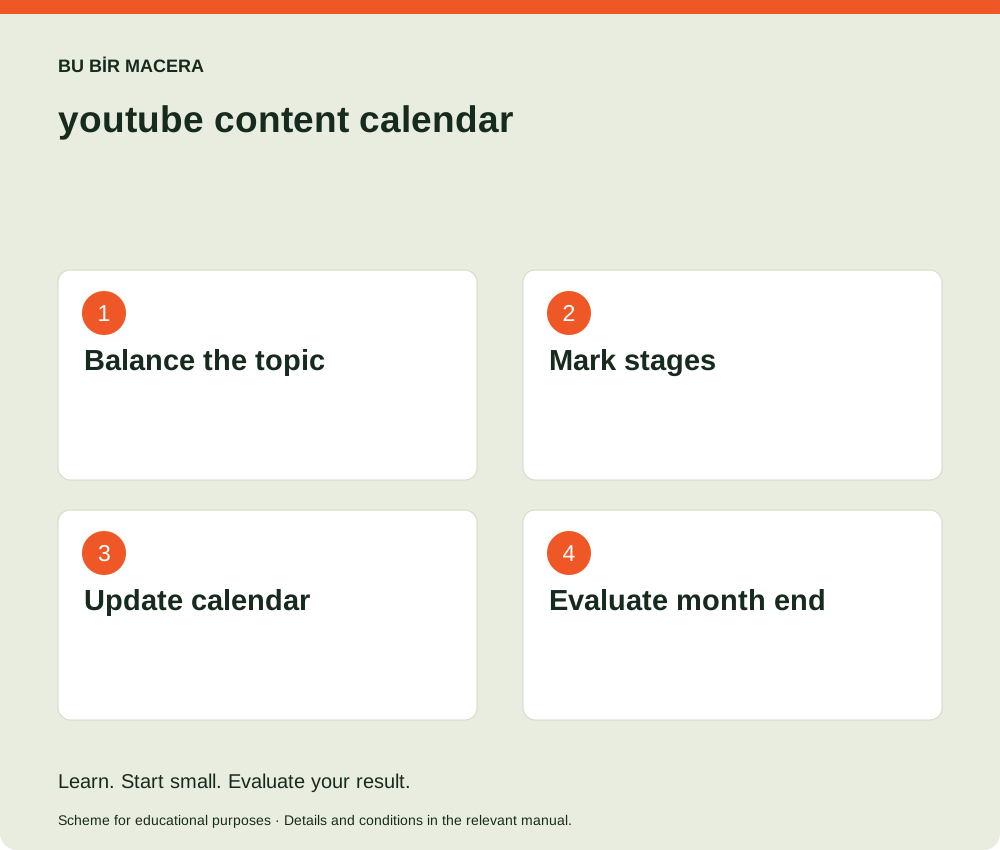
- Balance the topics
- Mark the milestones
- Update the calendar
- Evaluate the end of the month
Vehicle selection and actual starting cost
You don't need an expensive tech stack to start with for this topic. A calendar, project board, and shot list are enough to establish most basic flows. Sponsor tracking table provides process order; The idea bank helps record the results. Switching to a paid tool only when you see that the free option creates a tangible bottleneck preserves cash flow, especially before revenue is generated.
The most important criterion in choosing a tool is not popularity, but reducing friction in the workflow. A tool might make sense if it saves you two hours a week or significantly improves the quality of delivery. On the other hand, software, equipment or subscriptions purchased just to look professional may not produce a return. Write down the monthly cost of each paid tool and the time it saves you.
By what indicators should one evaluate the result?
In this study, follow the result, not just the movement. Let your first indicator be “planned/published rate” and the complementary indicator be “edit delay”. The recovery of one does not mean that the other has also recovered. Proceed by comparing similar jobs with the same date range, same calculation format. State what changes you made to the record and when; so you can investigate why the result may have changed.
Changing the entire plan based on one good day or exceptional result. At the end of the essay, explain in a brief note what you kept, what you fixed, and what you let go. Do not write about a result that you cannot measure as if it happened. In revenue-related studies, keep collection and turnover separate, and in growth studies, keep access and real interest separate. A few reliable records needed to choose the next step are more useful than one large report that is never used.
- planned/published rate
- edit delay
- shooting cost
- serial performance
- sponsored on-time delivery
Frequently asked questions
What study should I complete initially?
Add subject, viewer question, format, responsible, shooting day, broadcast day, status and post-broadcast learning columns to your table. Don't consider unfinished content ready just to make the calendar look full. At the end of the month, write down which topics are delayed and why and which series will continue. Your output is a living calendar that shows the difference between planning and actual production.
How soon can I get results?
There is no fixed term or income guarantee. The needs of the target audience, your skills, resources and application determine the result. Complete the concrete output in the article on the first try; Make your decision to move forward with real feedback and cost.
Resources and current conditions
Platform rules and legislation are subject to change. The calculation and application examples on the page are for educational purposes only; Please also check the relevant conditions from the official sources below.